
The Hidden Cost of Self-Sacrificing
Why the “strong ones” are often also the lonely ones.
TL;DR:
The most overlooked cost of always being the strong one isn't burnout. It's loneliness — the kind that comes from being surrounded by people who only know or value you in superhero “I have no needs” mode - not the real you.
A Big Assumption
Most people assume the biggest cost of always putting everyone else first is burnout.
Burnout is certainly a part of it! But it's not the whole story.
The consequence I think gets missed almost entirely — and that I rarely see talked about anywhere — is loneliness. Not the loneliness of too few people. The loneliness of being surrounded by people who only know one version of you.
There are two things going on here:
1) A self-selection problem. When you don't appear to have any needs, you tend to attract and keep the people who are happy with that set-up. People who want a genuine give-and-take relationship eventually drift off, because they keep getting the same message — "I'm fine, I'm fine" — and there's nowhere for them to go with it.
2) The cost of being capable. Everyone around you only knows the endlessly reliable version. The one who says yes. The one who copes. Nobody gets to meet the person underneath the coping, because you've never let them.
Self-sacrifice isn't always just kindness
Something I've noticed over the years is that self-sacrifice is rarely only about being generous.
Often it's also about staying safe.
There’s a certain layer of protection that comes from being the one to take care of everyone and everything else. Nobody sees you struggling, or thinks of you as ‘weak’ for having needs. And nobody gets the chance to dismiss those needs, because you've never let them see you have any.
For most people this isn't a conscious strategy. It builds over years.
Maybe you grew up feeling responsible for other people's emotions. Maybe being useful was the most reliable way to feel secure in your relationships. Whatever the reason, it can become such an automatic way of relating that you genuinely stop noticing you're doing it.
Being needed isn't the same as being known
I talk about this a lot with clients - the difference between being appreciated for what you do and being loved for who you are.
They're not the same thing.
If you're always organising, helping, rescuing, smoothing the way for everyone else — people will value you. But they may have no idea what scares you, what excites you, what wears you out, what actually fills you back up.
Real closeness needs more than reliability. It needs two people who actually know each other. And that's almost impossible when one of them is permanently hiding the parts of themselves that don't feel acceptable.
And then life happens
At some point, life tends to catch up with us.
People get sick. They burn out. They have kids. They lose someone they love. Or they simply hit a point where they can't keep saying yes to everything.
That's usually when the lopsided relationships start to wobble.
Relationships built on mutual care tend to adapt — the give and take shifts around to meet the new reality. But the ones that quietly depended on you always being available? Those get strained. And you start hearing things like:
“You’ve changed so much.”
“You’re not there for me anymore.”
Or, the real gut punch!
“I can’t believe how selfish you’re being.”
Which is a particularly cruel thing to put on someone who has spent years putting everyone else first.
But here's the uncomfortable truth in it: if a relationship only works as long as one person ignores their own needs, it was never especially healthy to begin with.
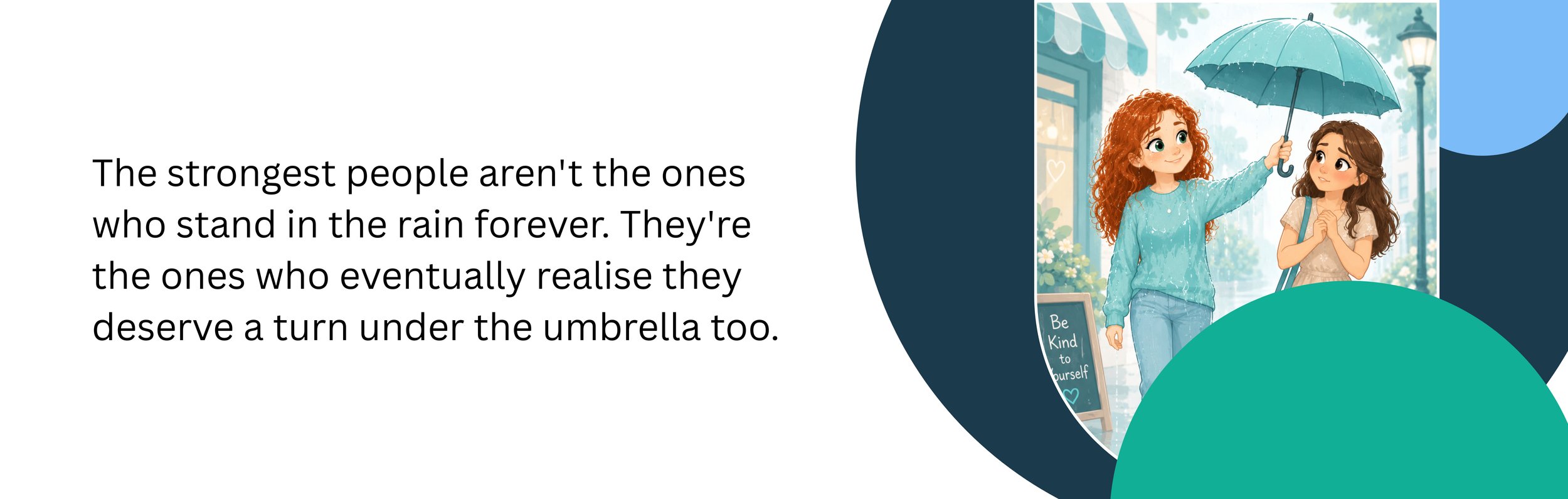
Why receiving help feels so harder
For a lot of people, accepting support is sooooo much harder than offering it.
Letting someone help means letting them see that you're tired, or overwhelmed, or unsure. It means trusting that you'll still matter to them even when you're not the one holding everything together.
If you grew up around conditional acceptance, criticism, or having your feelings waved away — that's an enormous ask. Not a character flaw. A learned, sensible response to an environment that taught you needs were risky.
Healthy relationships move in both directions
Healthy relationships aren't perfectly balanced at every moment. Sometimes one person carries more because life is genuinely harder for them right now.
But over time, the care moves both ways. Both people get to have needs. Both get to be supported. Both get to have their bad days without the whole thing tipping over.
The cost we don't always notice
The biggest loss here isn't energy. It isn't even being taken for granted, as grim as that is.
It's that, over time, you lose touch with yourself.
You stop noticing your own preferences, because you're always adapting to everyone else's. You stop recognising your limits, because you've spent years pushing straight through them. And somewhere in there you start to believe that your value lives entirely in what you do, rather than who you are.
The good news is that these patterns can shift.
It takes time, and usually a few painful lessons along the way. But the mechanics are surprisingly simple. Saying, "Actually, that doesn't work for me." Letting someone help when they offer. Allowing people to see the real you instead of the relentlessly competent stand-in.
It's bloody uncomfortable. Downright terrifying at times.
But it's also where the real connection starts. Because the people who are capable of healthy relationships don't just want your help.
They want you.
Ready to Stop Carrying Everyone Else?
If this blog hit a little close to home, I promise - you are not alone!
Learning to notice your own needs after years of putting everyone else first isn't easy - or selfish.
It's a skill. And like any skill, it becomes easier with support and practice.
If you're a therapist, business owner, or other healthcare professional, I offer individual SPARKSFIRE coaching to help you recognise the patterns that lead to burnout, self-sacrifice and over-functioning, while building a more sustainable way of working and living.
If you're looking for support with this as a client, our team at 12 Points Psychology can help you explore the costs and benefits of self-sacrificing, strengthen boundaries, and develop more balanced, reciprocal relationships without losing the kindness that makes you who you are.
Trust me, you don’t need to figure this out on your own anymore.
Danielle Graber
Clinical Psychologist & Director
—————————————————————-
Recommended Links
SPARKSFIRE Coaching for Clinicians
Supporting therapists and helping professionals to work sustainably, reduce burnout and reconnect with what matters.
12 Points Psychology
Book an appointment with one of our psychologists or therapists to explore people-pleasing, boundaries, self-worth and healthier relationship patterns.
The Centre for Clinical Interventions (CCI)
Free, evidence-based resources on assertiveness, self-esteem and unhelpful thinking styles that complement therapy.
