
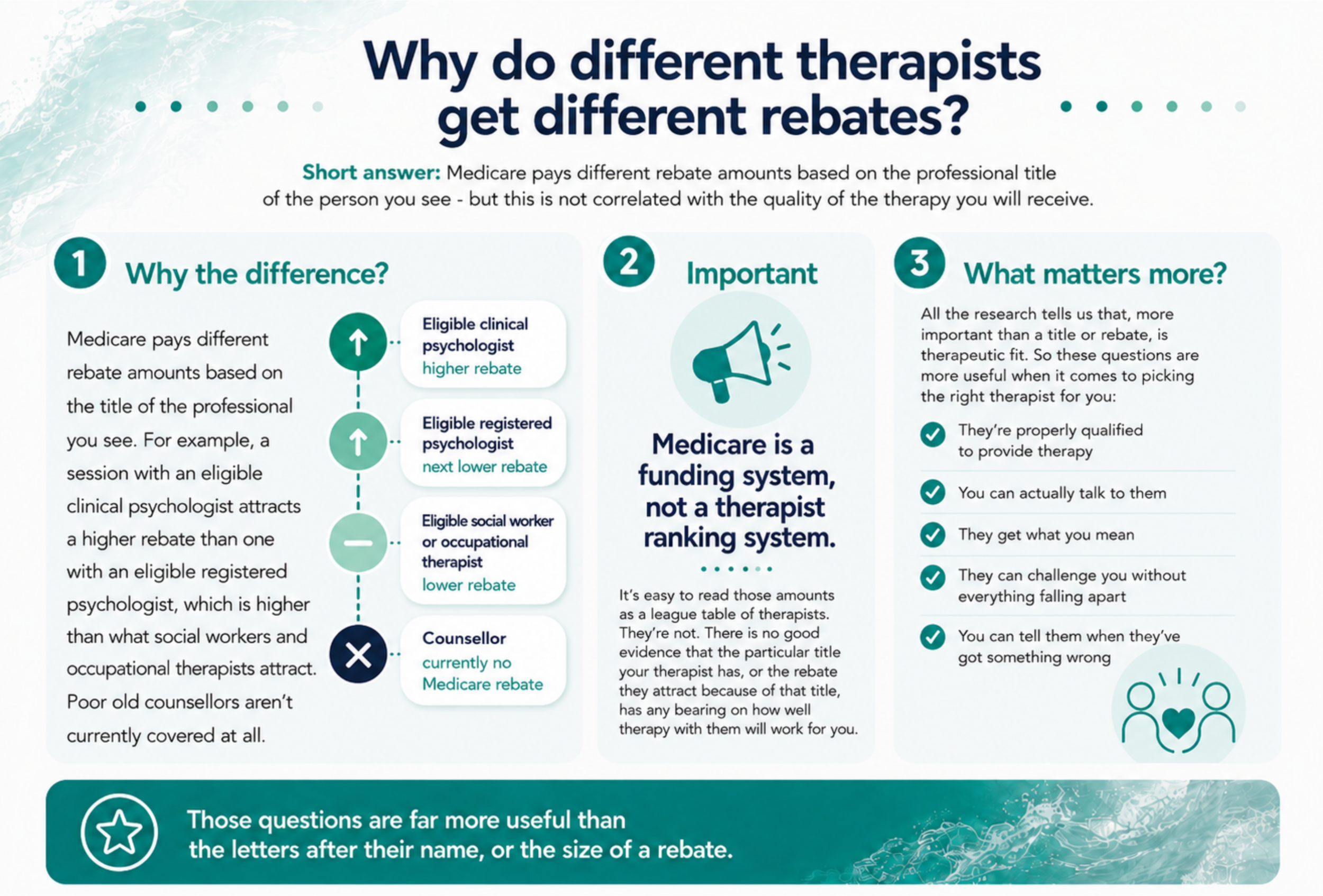
Medicare is a funding system - not a therapist ranking system
How do Mental Health Treatment Plans Actually Work?
TL;DR:
Mental Health Treatment Plans come with a lot of myths and misunderstandings! So here's the plain version - minus the Medicare-speak.
What is a Mental Health Treatment Plan (MHTP)?
Think of an MHTP (also called a Mental Health Care Plan) a bit like a specialist referral letter.
Usually, it works something like this:
Book an appointment with your GP. Tell them it is for a MHTP, as they may need to book a longer appointment.
Your GP talks with you about what is going on and whether a MHTP is suitable.
Your GP gives you a referral to an eligible mental health professional – either someone they recommend or someone you would like to see.
You start therapy. Your first course of treatment is usually for six sessions.
If/when you need access to additional sessions, your therapist writes a letter back to your GP who reviews how things are going. If suitable, you can get a re-referral for further sessions, up to the Medicare limit for that year.
That referral is what lets you claim a Medicare rebate for eligible sessions.
The important word there is rebate. An MHTP doesn't mean you get 100% of the fee paid back. Medicare covers part of the cost: your therapist charges their normal fee, Medicare gives you some of it back, and you're out of pocket for the difference.
Why don't all psychologists bulk bill?
Some still do, but it's definitely becoming increasingly difficult for private practices to offer bulk billing.
What most people don’t realise is that, unlike GPs who receive additional Medicare incentive payments for bulk billing, psychologists and other allied health clinicians don't have access to those same subsidies. They only receive the rebate amount. So if that sits below what the appointment actually costs, the therapist, or their clinic, wears the gap.
Psychologists have the same costs as other private health professionals: rooms, staff, insurance, registration, software, supervision and ongoing training. Those costs have risen steeply, like everything else unfortunately, and Medicare rebates have not kept pace.
Allied health indexation was actually frozen for almost seven years (ceased in November 2012, not resuming until July 2019). By the time it finally did restart - it was a long way behind.
This is why, here at 12 Points Psychology, we do not bulk bill.
How many sessions does Medicare help pay for?
Under the current Better Access scheme, eligible people can claim rebates for up to 10 individual sessions per calendar year. Your first referral covers up to six; your GP can review and refer you for more, up to the annual limit.
But this bit really matters: Medicare rebated-sessions running out and therapy being done are two very different things. The 10-session limit is a funding decision, it is not based on any clinical evidence - because not every human is “all better” after 10 appointments.
Some people come to therapy for one fairly contained issue and do only need a few sessions. Others are working through long-standing or chronic difficulties, significant mental health diagnoses, major losses or life changes, or several of those things tangled up together.
Research shows there is a lot of individual variation, with meaningful, lasting change often taking 15 sessions or more.
So 10 sessions tells you what Medicare will subsidise. It doesn’t tell you how much therapy you might benefit from.
So what do I actually need to know?
An MHTP is useful and can make therapy more financially manageable. But it helps to know exactly what it does provide - and what it doesn’t:
• It is not 10 free sessions.
• It is not a promise that 10 sessions will be enough.
• The rebate rarely covers the full cost of the appointment.
• The rebate size doesn't tell you whether someone is the right therapist for you.
Find someone with the right training and experience for what you need, and who you feel comfortable working with. That's the bit that matters.
If you’re thinking about getting started:
If you're not sure how the Medicare side works for your situation, you're welcome to get in touch. We're happy to talk through how an MHTP might apply, what our fees look like, how to plan the timing of Medicare-rebated vs private sessions to suit your budget and needs, and whether we're the right fit for you and where you’re at right now. No pressure either way. You can check out our available clinicians here, or get in touch via our contact page.
Danielle Graber
Clinical Psychologist & Director
—————————————————————-
