
Don’t Wait Until They’re Dating to Teach Them About Consent
Before the walls go up - make sure there’s a solid foundation.
This article contains references to sexual violence.
———————————————————————————————————————-
TL;DR: Consent education does not begin when teenagers start dating. Think of it like building a house: long before we get to conversations about sex, we need to have laid the foundations of empathy, bodily autonomy, and respect.. Children first need to learn that their body belongs to them, that another person’s “no” matters, and that disappointment never gives us permission to override somebody else’s boundaries.
———————————————————————————————————————-
The allegations coming out of Cornell University are absolutely horrifying.
A former student, known publicly as Jane Doe, has alleged in a civil lawsuit that she was drugged and sexually assaulted by multiple members of a fraternity in 2024. Seven former fraternity members are named in the lawsuit. A criminal investigation has now been reopened, but at the time of writing no criminal charges have been announced and the allegations remain just that: allegations.
You may have seen the men referred to online as the “Cornell Seven”. I’m deliberately not using that as shorthand here. Frankly, it sounds more like an a cappella group than seven men accused of serious sexual violence.
Language matters.
Especially because our kids are listening.
What do your kids hear you asking?
Unfortunately, when something terrifying and senseless happens, our brains naturally go looking for an explanation. We want to find something we can point to and think, “Well, I wouldn’t do that, so maybe this couldn’t happen to me.”
Psychologists sometimes describe this as part of the just-world fallacy: our tendency to want to believe that the world is predictable and that people’s actions somehow explain what happens to them. That belief can give us a temporary sense of control.
But it can also shift our attention towards what the victim did in the lead-up, rather than towards the choices made by the perpetrator.
And our kids hear that distinction.
So pay attention to the questions being asked around your dinner table, in the car, or while scrolling. Those automatic thoughts might pop up, but we don’t have to give them the microphone:
“Why she was drinking so much?”
“Why did she go upstairs with him?”
“What she was wearing?”
And make sure those questions don’t get more airtime than this one:
Why would anyone believe that sexual activity with a severely impaired person was acceptable?
Reports about the Cornell allegations also describe messages circulated among fraternity members while the alleged events were occurring. What each individual person saw, understood or knew remains part of the, as yet, unresolved legal story.
But common sense also makes it difficult to believe that, in a group chat of around 50 people where messages about what was allegedly happening were being circulated, not a single person recognised that something was seriously wrong.
And that matters.
Because consent education isn’t only about teaching our kids not to harm someone themselves. It’s also about teaching them to notice when somebody else may be vulnerable, unsafe or unable to advocate for themselves, and to understand that doing nothing is still a choice.
But those instincts don’t suddenly appear the first time our kids are faced with a high-stakes situation.
They don’t magically land fully formed in their brains at 14, or 16, or 21.
We need to build them. Which is why:
Consent conversations with kids need to start early
Consent Is a Relationship Skill, Not a Sex Talk
As a clinical psychologist whose worked with kids, teens and adults for over 15 years, what I wish more of us understood is that – you can’t treat the topic of consent like it’s just a ‘sex talk’.
Because that’s:
Not what it is, and,
A pretty effective way of making parents feel awkward enough to keep putting the conversation off until “they’re just a bit older”.
In fact, understanding consent is a critical relationship skill.
It ties into everything from empathy to emotional regulation, self-esteem to impulse control.
And just like any solid structure, we don’t start with the roof.
We start with the foundations.
And it starts sometimes even before your toddler’s first, “NO”.
Preschool: laying the foundations
Consent conversations at this stage need to be very concrete.
“Would you like a hug?”
“You said stop, so I stopped tickling.”
“You don’t have to kiss Grandma goodbye if you don’t want to. Let’s wave instead.”
But there’s another bit here that we sometimes forget:
“She doesn’t want a hug right now. So we need to listen.”
We are teaching both:
Your boundaries matter - AND - Other people’s boundaries matter too.
That is the concrete slab everything else gets built on.
Primary school: putting up the framing
As children get older, consent expands beyond physical touch.
“Ask before borrowing something.”
“Don’t share somebody’s photo without permission.”
“Stop when someone asks you to stop.”
And importantly:
"You are allowed to feel disappointed by somebody’s boundary. You are not allowed to ignore it because you are disappointed.”
That lesson really matters.
Because respecting a boundary you don’t particularly like is part of learning emotional regulation, empathy and responsibility.
The frame is getting stronger.
Teenagers: making the structure liveable
By adolescence, we need to be explicit about relationships, kissing, sexting, sexual behaviour, alcohol and pressure.
Consent must be clear, freely given and ongoing.
And it can absolutely be all those things without killing the vibe. (Check out The Love Hypothesis on Prime if you don’t believe me.)
But silence is not consent.
Pressure is not consent.
Consent to one thing is not consent to everything.
Someone sending you an intimate image is not permission to share it.
And anyone can change their mind. At any time.
Australian esafety guidance makes the same point: pay attention to whether somebody actually seems comfortable, remember that alcohol or drugs can affect their capacity to consent, and keep checking in rather than assuming one “yes” covers everything.
Because two of the most powerful relationship skills we can give our kids are:
If you’re not sure, ask.
If you don’t want to, say so.
And, at this stage, these conversations are much easier when they’re not the first bricks we’ve ever laid.
Consent also means noticing what’s happening around you
Consent education cannot stop at “don’t hurt someone”.
What happens when your child sees a friend pressuring somebody?
When a degrading photo is shared in a group chat?
When somebody is intoxicated and clearly vulnerable?
When everyone else is laughing at an offensive joke?
We need our kids to know that another person’s vulnerability is not entertainment, opportunity or “somebody else’s” problem, and to have the courage to act when they need to.
And this is another reason those early conversations matter so much.
When we give children language for things like boundaries, discomfort, pressure, consent and changing your mind, we give them words they can actually use when something feels wrong. It becomes easier to recognise what they’re seeing, name it, and make an informed decision about what to do next.
Just as importantly, every one of those conversations sends another message: this is something you can talk to me about.
So if they eventually find themselves in a confusing situation, whether they’re worried about themselves or somebody else, they’re not starting from scratch. They already have the language, and hopefully the confidence, to speak up, ask for help or come back and tell you what happened.
That safety net is part of the foundation too.
They’re always learning from us
Those foundations need to be in place long before university, or even high school.
It starts when we teach them to notice discomfort, respect boundaries, cope with rejection, speak up and get help. And that happens every day in 100 different ways.
Children notice whether we stop tickling when they say stop.
Whether we force affection for politeness.
Whether we knock before entering their room.
Whether we share embarrassing photos without asking.
Whether we accept “no” without sulking, teasing or retaliation.
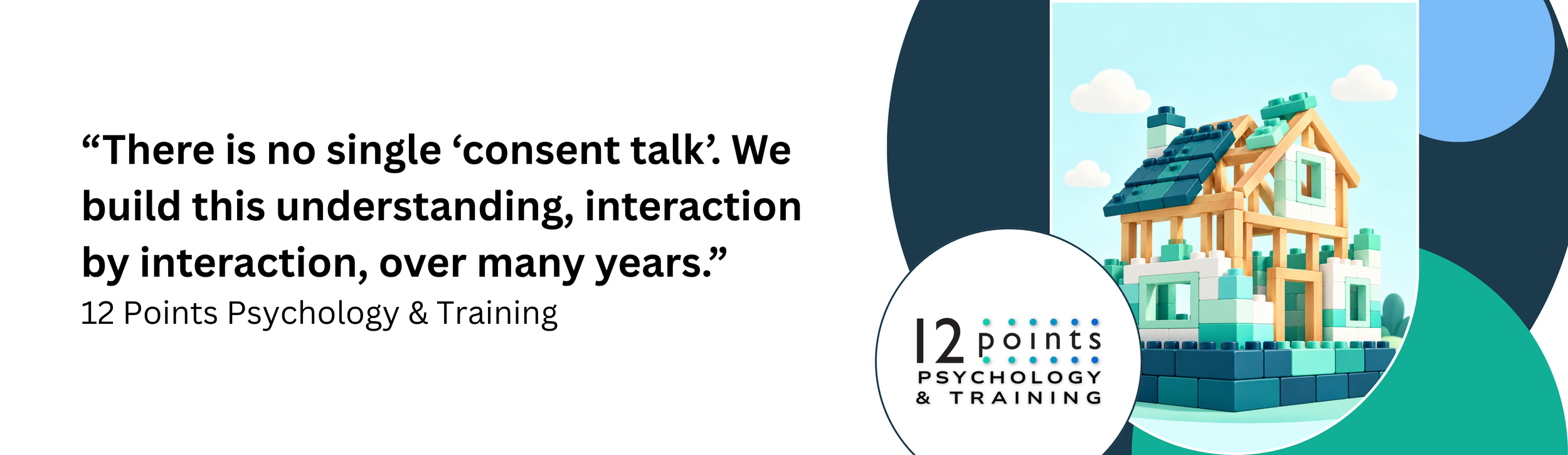
There is no single “consent talk”.
We build this understanding, interaction by interaction, for years.
So before the walls go up, make sure the foundations are solid.
—————————————————————-
Need Help Knowing Where to Start?
If you’re not sure how to start these conversations with your child or teen, you don’t have to figure it all out at once. Give us a call, or send us a message via our online booking form.
Our psychologists and counsellors can support parents and young people with conversations around boundaries, relationships, emotional regulation and communication.
You can join us for sessions in our Ferntree Gully rooms, or work with us via telehealth from anywhere in Australia.
